13 times table
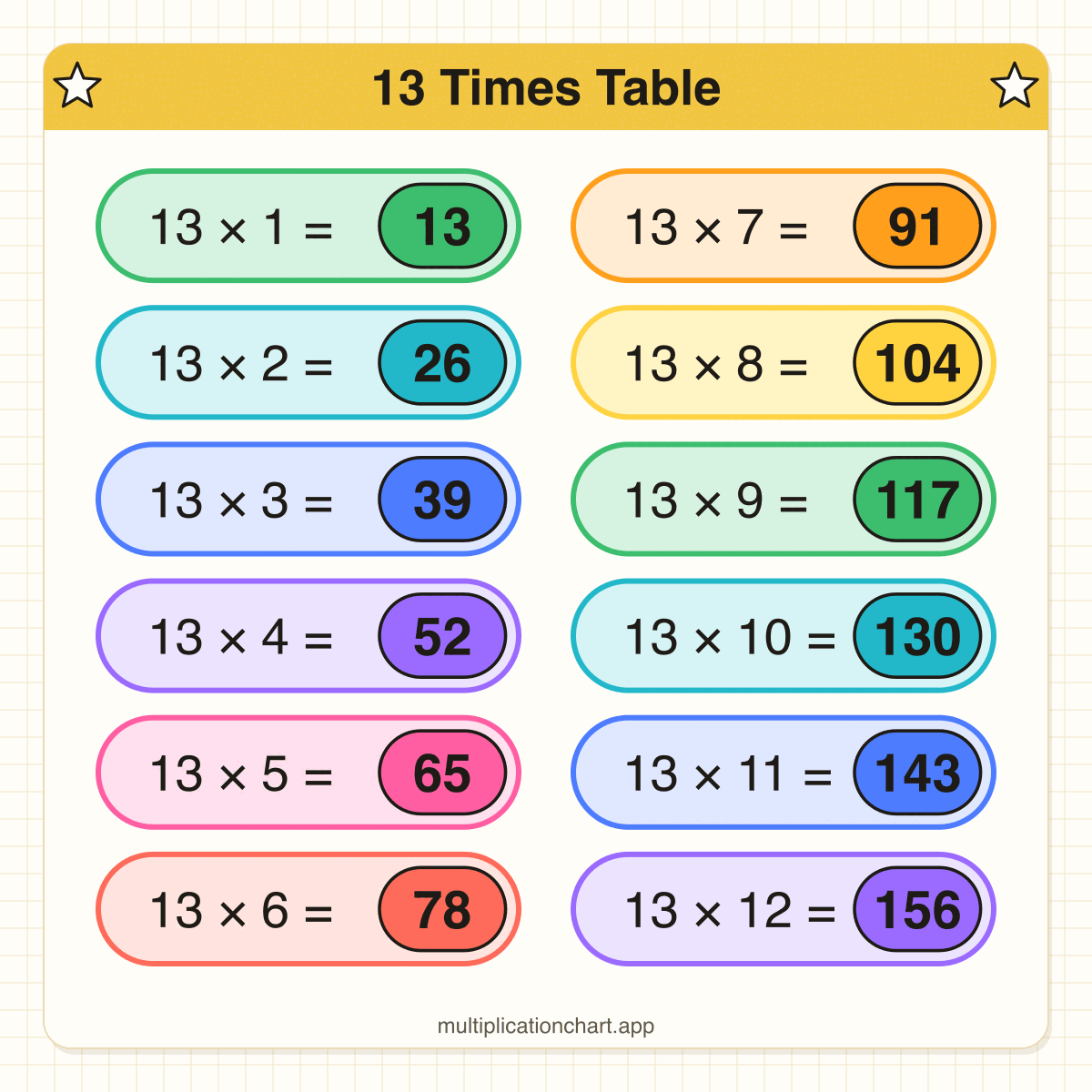
The 13 times table counts up in 13s: 13, 26, 39, 52, 65, 78, 91, 104, 117, 130, 143, 156. Each answer is 13 more than the one before, so 13 × 12 = 156. Print it below as a chart, a practice sheet or a shuffled test, each with the answers.
Print the 13 times table
Each PDF is one page, or two when it has an answer key. The shuffled test mixes up the order, so the answers cannot be read off by counting on.
| Sheet | US Letter | A4 |
|---|---|---|
| 13 × 1 to 13 × 12 | PDF (1 page, 3 KB) | PDF (1 page, 3 KB) |
| 13 × 1 to 13 × 20 | PDF (1 page, 5 KB) | PDF (1 page, 5 KB) |
| Answers blank, in order, with answer key | PDF (2 pages, 6 KB) | PDF (2 pages, 6 KB) |
| Answers blank, shuffled, with answer key | PDF (2 pages, 6 KB) | PDF (2 pages, 6 KB) |
To change the sheet first (up to × 10, × 12 or × 20, division facts, or a new shuffled order), use the sheet maker below. It prints and saves a PDF the same way.
13 Times Table
- 13 × 1 = 13
- 13 × 2 = 26
- 13 × 3 = 39
- 13 × 4 = 52
- 13 × 5 = 65
- 13 × 6 = 78
- 13 × 7 = 91
- 13 × 8 = 104
- 13 × 9 = 117
- 13 × 10 = 130
- 13 × 11 = 143
- 13 × 12 = 156
US Letter, 1 page. Print at 100% (Actual size), not Fit to page.
The 13 times table up to 20
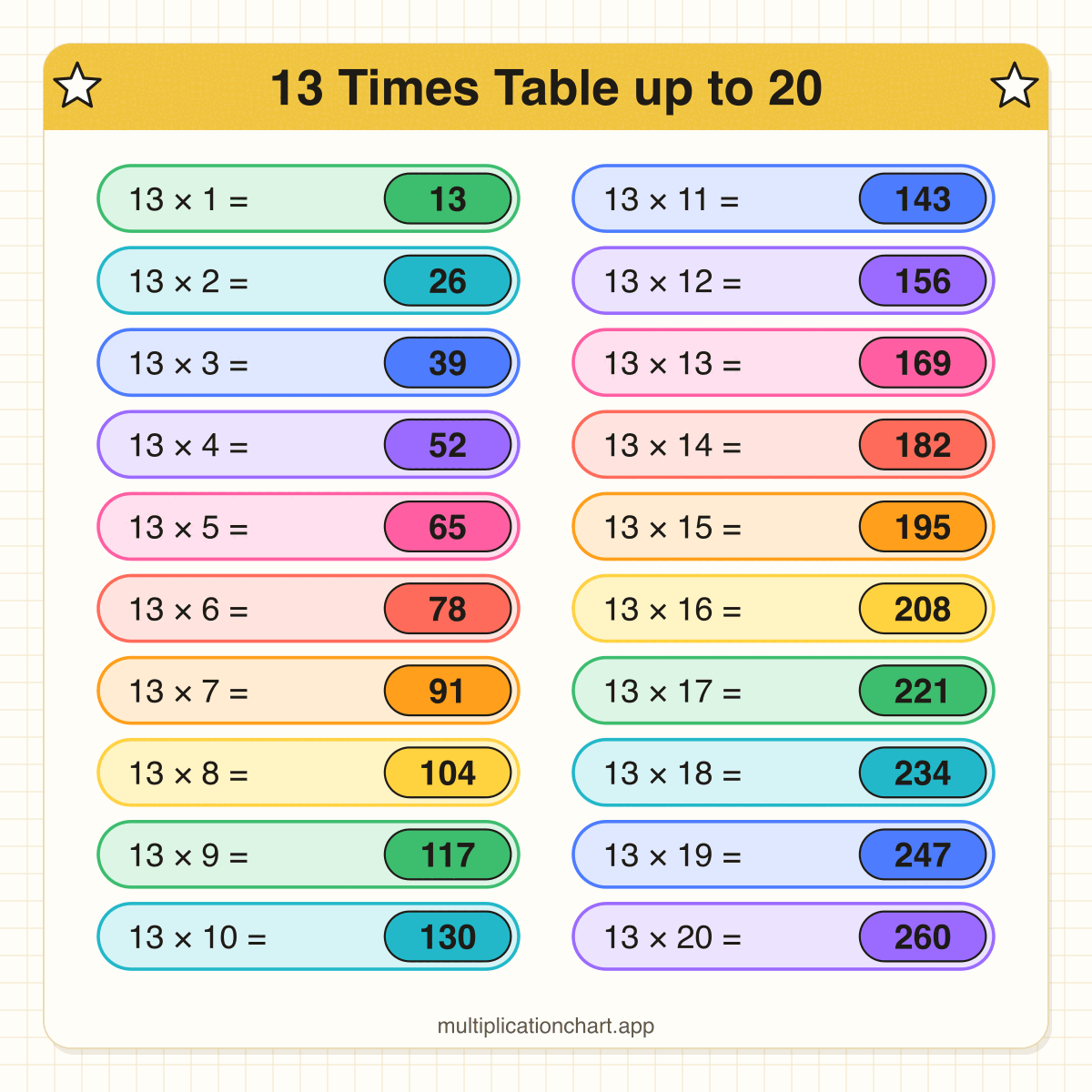
Past × 12 the answers keep growing by 13: 13 × 13 = 169 and 13 × 20 = 260.
- 13 × 13 = 169
- 13 × 14 = 182
- 13 × 15 = 195
- 13 × 16 = 208
- 13 × 17 = 221
- 13 × 18 = 234
- 13 × 19 = 247
- 13 × 20 = 260
Tricks for the 13s
- Ten groups and three groups: 13 × 7 = 10 × 7 + 3 × 7 = 70 + 21 = 91.
- Use the 12s: Thirteen groups are twelve groups and one more. 13 × 8 = 12 × 8 + 8 = 96 + 8 = 104.
- Count on in 13s: Add 10, then add 3. From 52: 52 + 10 = 62, and 62 + 3 = 65, so 13 × 5 = 65.
The ones digits follow the 3s: 13 × 4 = 52 ends in 2, just as 3 × 4 = 12 does. In the first ten answers every digit from 0 to 9 turns up once.
Dividing by 13
Every multiplication fact gives a division fact: 13 × 7 = 91, so 91 ÷ 13 = 7.
- 13 ÷ 13 = 1
- 26 ÷ 13 = 2
- 39 ÷ 13 = 3
- 52 ÷ 13 = 4
- 65 ÷ 13 = 5
- 78 ÷ 13 = 6
- 91 ÷ 13 = 7
- 104 ÷ 13 = 8
- 117 ÷ 13 = 9
- 130 ÷ 13 = 10
- 143 ÷ 13 = 11
- 156 ÷ 13 = 12
Check yourself
- 13 × 6 = ?
- 13 × 9 = ?
- 13 × 12 = ?
- 13 × 15 = ?
- 91 ÷ 13 = ?
- 143 ÷ 13 = ?
- A baker's dozen is 13. How many rolls are in 4 baker's dozens?
Show the answers
- 13 × 6 = 78
- 13 × 9 = 117
- 13 × 12 = 156
- 13 × 15 = 195
- 91 ÷ 13 = 7
- 143 ÷ 13 = 11
- 4 × 13 = 52 rolls.
Where the 13 times table fits
In England, Year 4 pupils should "recall multiplication and division facts for multiplication tables up to 12 × 12". In the US, Common Core 3.OA.C.7 asks children to know every product of two one-digit numbers from memory by the end of Grade 3. The 13s come next, with multi-digit multiplication. Common Core 4.NBT.B.5 for Grade 4 says: "Multiply a whole number of up to four digits by a one-digit whole number, and multiply two two-digit numbers, using strategies based on place value and the properties of operations." 13 × 7 is a two-digit number times a one-digit number, and splitting the 13 into 10 and 3, as in the tricks above, is one of those strategies.
Sources
- Common Core State Standards for Mathematics, Grade 3 Operations and Algebraic Thinking: 3.OA.A.1, 3.OA.B.5, 3.OA.B.6, 3.OA.C.7, 3.OA.D.9; wording checked against the official standards PDF (page 23)
- Common Core State Standards for Mathematics, Grade 4 Number and Operations in Base Ten: 4.NBT.B.5, multi-digit multiplication; wording checked on the page on 25 October 2026
- National curriculum in England: mathematics programmes of study (Department for Education, 2013): Years 2, 3 and 4 times-table statements; Year 5 square numbers
- Cambridge Dictionary: baker's dozen: 13; checked 25 October 2026
Last checked October 25, 2026.