Multiplication chart 1-40
A multiplication chart 1-40 is a 40 × 40 grid of products, from 1 × 1 = 1 to 40 × 40 = 1,600. Find one number down the left side and the other across the top: the square where they meet is the answer. Print it below in color, in black and white or blank, on US Letter or A4.
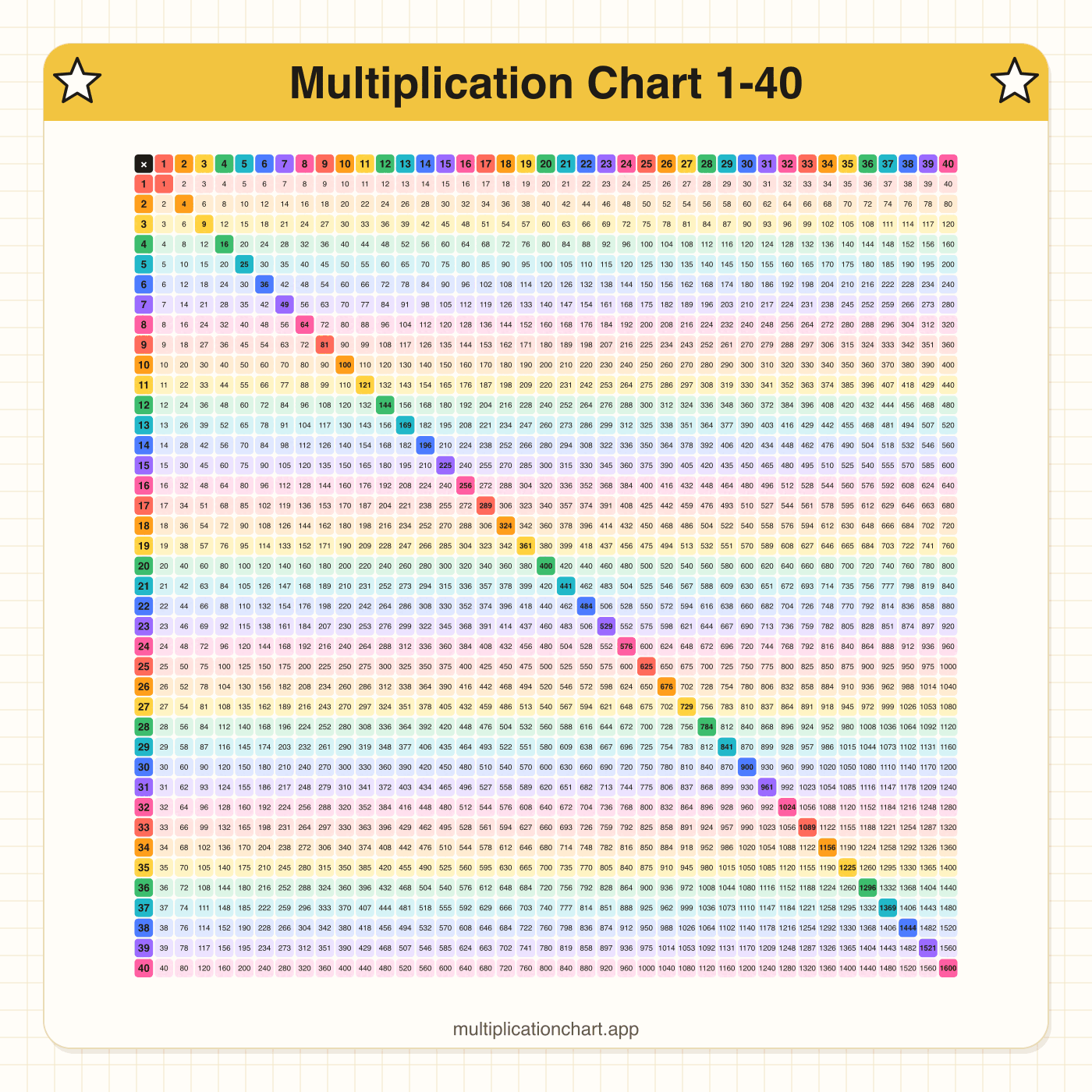
Print the multiplication chart 1-40
On one US Letter page the products print at 5 points, smaller than most printed text, so the one-page chart suits a wall or a binder you read up close. For everyday use, print the large-print version: four pages of 20 × 20 squares with the products at 9.7 points. The blank chart comes as four pages too, because a one-page square (4.6 mm) is too small to write a four-digit answer in.
| Sheet | US Letter | A4 |
|---|---|---|
| Color, one page | PDF (1 page, 109 KB) | PDF (1 page, 110 KB) |
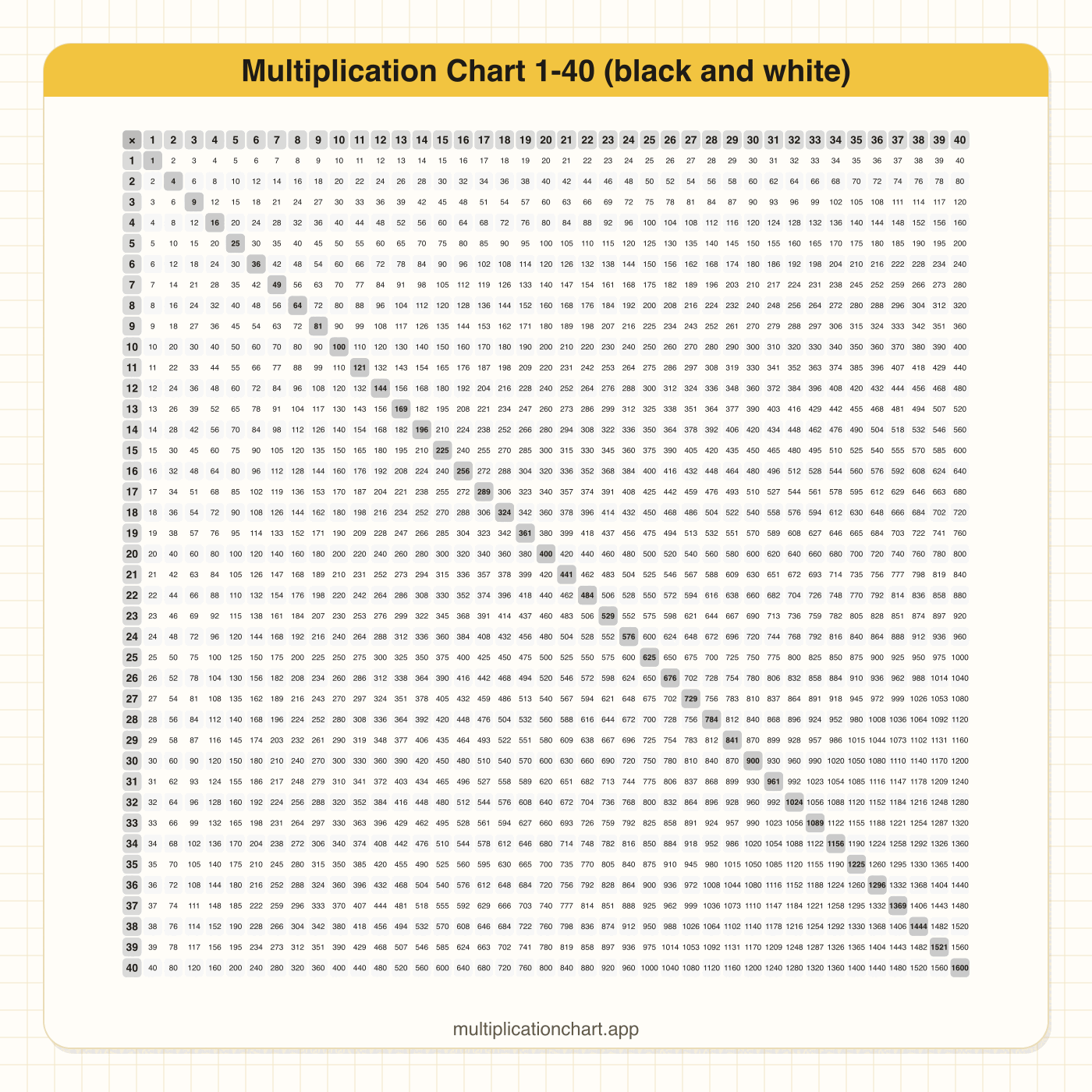
| Black and white, one page | PDF (1 page, 108 KB) | PDF (1 page, 109 KB) |
| Large print, 4 pages of 20 × 20 | PDF (4 pages, 123 KB) | PDF (4 pages, 124 KB) |
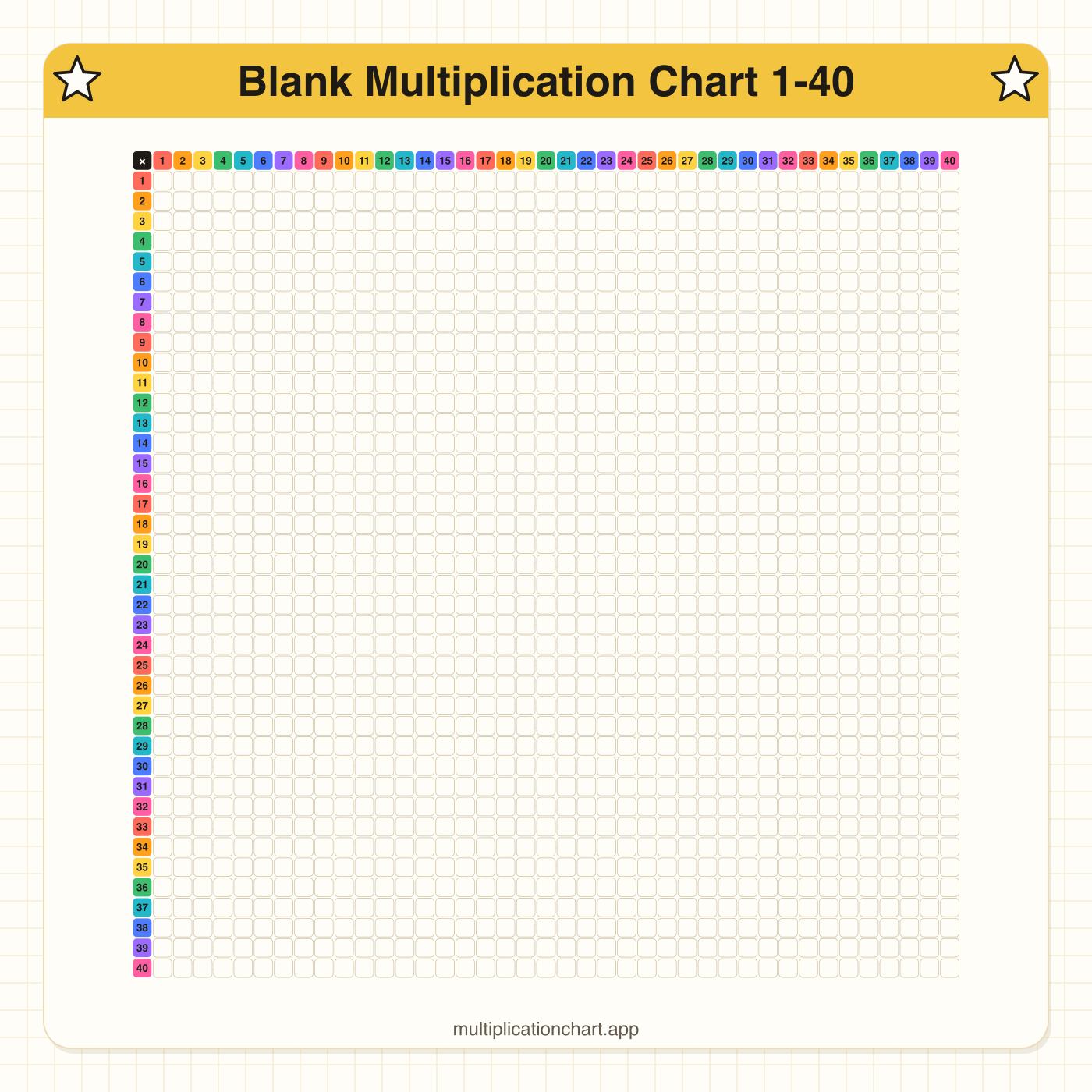
| Blank, 4 pages of 20 × 20, with answer key | PDF (8 pages, 143 KB) | PDF (8 pages, 144 KB) |
Black and white and blank charts
The black and white chart uses gray shading that copies well on a school photocopier. The blank chart keeps the numbers 1 to 40 along both edges and leaves every square empty to fill in.
How to read the 1-40 chart
- Find 36 in the colored column on the left and 27 in the colored row across the top.
- Follow row 36 across and column 27 down. They meet at 972, so 36 × 27 = 972.
- Division works backward: to find 972 ÷ 27, go down column 27 to 972 and read the number at the start of that row, 36.
The 1-40 chart in numbers
Our chart generator counted these. We count 36 × 27 and 27 × 36 as one fact, because they match on opposite sides of the diagonal.
| Chart | Squares | Different facts | Different products | Largest product |
|---|---|---|---|---|
| 1-12 | 144 | 78 | 59 | 144 |
| 1-20 | 400 | 210 | 152 | 400 |
| 1-40 | 1,600 | 820 | 517 | 1,600 |
| 1-100 | 10,000 | 5,050 | 2,906 | 10,000 |
So the 1-40 chart has 1,600 squares but only 517 different answers. The most repeated answer is 120, which appears 12 times.
Square numbers from 1 to 40
The diagonal from the top left corner to the bottom right holds the square numbers, each a number times itself. They are the bold squares on the chart.
- 1 × 1 = 1
- 2 × 2 = 4
- 3 × 3 = 9
- 4 × 4 = 16
- 5 × 5 = 25
- 6 × 6 = 36
- 7 × 7 = 49
- 8 × 8 = 64
- 9 × 9 = 81
- 10 × 10 = 100
- 11 × 11 = 121
- 12 × 12 = 144
- 13 × 13 = 169
- 14 × 14 = 196
- 15 × 15 = 225
- 16 × 16 = 256
- 17 × 17 = 289
- 18 × 18 = 324
- 19 × 19 = 361
- 20 × 20 = 400
- 21 × 21 = 441
- 22 × 22 = 484
- 23 × 23 = 529
- 24 × 24 = 576
- 25 × 25 = 625
- 26 × 26 = 676
- 27 × 27 = 729
- 28 × 28 = 784
- 29 × 29 = 841
- 30 × 30 = 900
- 31 × 31 = 961
- 32 × 32 = 1,024
- 33 × 33 = 1,089
- 34 × 34 = 1,156
- 35 × 35 = 1,225
- 36 × 36 = 1,296
- 37 × 37 = 1,369
- 38 × 38 = 1,444
- 39 × 39 = 1,521
- 40 × 40 = 1,600
Tricks for the bigger numbers
- The 40s: Multiply by 4, then by 10. 40 × 13: 4 × 13 = 52, and 52 × 10 = 520.
- 31 to 39: Split off the 30, multiply both parts and add. 34 × 7 = 30 × 7 + 4 × 7 = 210 + 28 = 238.
- Just under a ten: Round up, then take one group away. 39 × 6 = 40 × 6 − 6 = 240 − 6 = 234.
- Squares that end in 5: For 35 × 35, multiply the 3 by the next number, 4, to get 12, then write 25 after it: 1,225.
Splitting a number this way is the distributive property, the same idea as Common Core 3.OA.B.5: "Knowing that 8 × 5 = 40 and 8 × 2 = 16, one can find 8 × 7 as 8 × (5 + 2) = (8 × 5) + (8 × 2) = 40 + 16 = 56. (Distributive property.)"
Who needs a chart this big?
In the US, Common Core 3.OA.C.7 ends with "By the end of Grade 3, know from memory all products of two one-digit numbers." In England, Year 4 pupils should "recall multiplication and division facts for multiplication tables up to 12 × 12". Neither goes past 12 × 12, so a 1-40 chart is for looking answers up: checking long multiplication, finding factors and spotting patterns. To learn the facts themselves, start with the multiplication chart 1-12 and the times tables worksheets.
Sources
- Common Core State Standards for Mathematics, Grade 3 Operations and Algebraic Thinking: 3.OA.A.1, 3.OA.B.5, 3.OA.B.6, 3.OA.C.7, 3.OA.D.9; wording checked against the official standards PDF (page 23)
- National curriculum in England: mathematics programmes of study (Department for Education, 2013): Years 2, 3 and 4 times-table statements; Year 5 square numbers
Last checked October 25, 2026.